LiFePO4 Battery Heater: How to Choose the Right Heating Pad, Power and Temperature Control
LiFePO4 batteries, also known as lithium iron phosphate batteries, are widely used in energy storage systems, RVs, marine applications, portable power stations, UPS systems, solar energy storage, and electric equipment.
One important consideration for LiFePO4 batteries is low-temperature operation. When the battery temperature becomes too low, especially during charging, the battery may require temperature protection or controlled heating.
A properly designed LiFePO4 battery heater can warm the battery to a suitable operating temperature and help the battery management system maintain safe low-temperature operation.
This article explains how to select a LiFePO4 battery heating pad, calculate heating power, choose a temperature sensor, and design an automatic temperature control system.
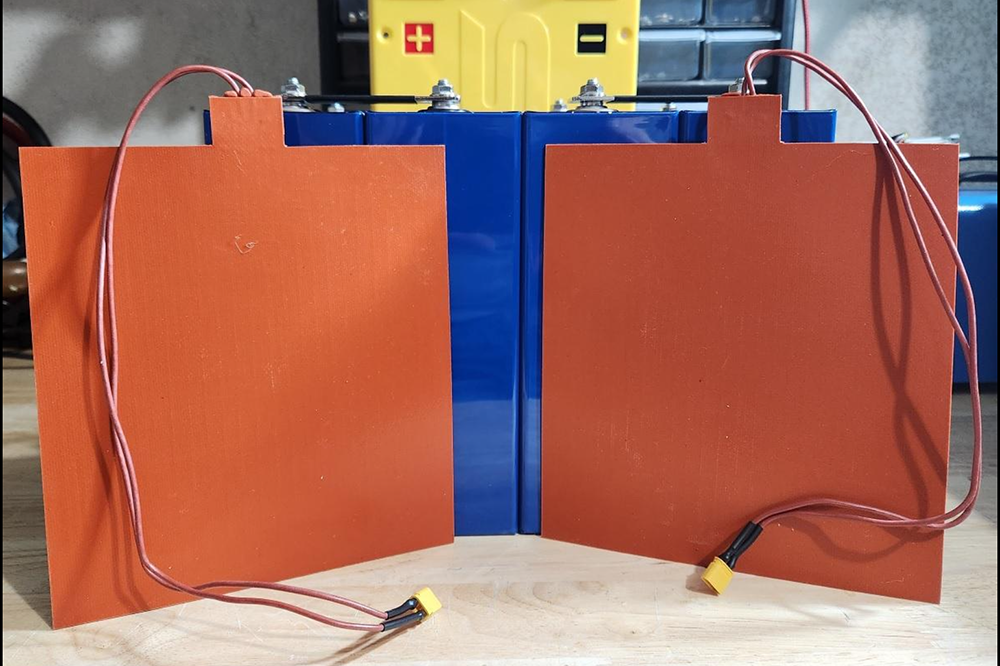
What Is a LiFePO4 Battery Heater?
A LiFePO4 battery heater is an electric heating device designed to raise the temperature of a lithium iron phosphate battery or battery pack.
The most common solution is a flexible silicone rubber heating pad installed directly on the battery enclosure or battery surface.
The heater normally consists of:
• Flexible silicone insulation
• Etched NiCr or resistance heating circuit
• Power leads
• Temperature sensor
• Optional adhesive backing
• Optional thermal protection
The heating pad converts electrical energy into heat and transfers the heat to the battery through direct contact.
For battery heating applications, flexible heaters are particularly useful because they can be manufactured in customized shapes and sizes.
Why Does a LiFePO4 Battery Need Heating?
LiFePO4 batteries have good thermal stability and long cycle life, but their performance is still affected by ambient temperature.
Low temperatures can reduce battery performance and charging capability. In particular, charging a LiFePO4 battery at temperatures below the manufacturer’s permitted charging range can cause lithium plating and permanent battery damage.
For this reason, many battery systems use a low-temperature charging protection strategy.
Instead of allowing the battery to remain too cold, a heating pad can raise the battery temperature before or during charging.
A typical system may use the following logic:
Battery temperature ≤ 2°C → Heater ON
Battery temperature ≥ 5°C → Heater OFF
This temperature hysteresis prevents the heater from switching on and off too frequently.
The actual temperature limits should always follow the battery cell manufacturer’s and BMS manufacturer’s specifications.
Recommended Heating Pad for a 12.8V 100Ah LiFePO4 Battery
For a typical 12.8V 100Ah LiFePO4 battery, a silicone rubber heating pad with approximately 80–120W of heating power can be considered as a starting point.
A commonly used specification is:
Parameter | Recommended Specification |
Battery | 12.8V 100Ah LiFePO4 |
Heater Type | Silicone Rubber Heating Pad |
Heater Voltage | 12V DC |
Recommended Power | 80–120W |
Typical Starting Point | 12V / 100W |
Temperature Sensor | NTC 10K |
Heater Thickness | Approximately 1.5–2.0 mm |
Adhesive Backing | Optional |
Temperature Control | ON/OFF with hysteresis |
Example ON Temperature | ≤2°C |
Example OFF Temperature | ≥5°C |
Independent Over-Temperature Protection | Recommended |
The final heater specification should be determined according to battery size, enclosure construction, insulation, ambient temperature, target heating time, and available electrical power.
How Much Heating Power Does a LiFePO4 Battery Need?
Heating power depends on several factors, including:
1. Battery mass
2. Battery material and specific heat capacity
3. Starting temperature
4. Target temperature
5. Battery enclosure
6. Thermal insulation
7. Heat loss to the surrounding environment
8. Required heating time
A simplified calculation can be used to estimate the required energy:
Q = m × c × ΔT
Where:
• Q = required thermal energy
• m = battery mass
• c = average specific heat capacity
• ΔT = required temperature increase
For example, if a battery weighs approximately 10 kg and needs to be heated from -20°C to 5°C, the temperature increase is:
ΔT = 25°C
Using an approximate average specific heat capacity of 1 kJ/kg·K:
Q ≈ 10 × 1 × 25 = 250 kJ
A 100W heater provides approximately 100 joules of energy per second.
The theoretical heating time is therefore approximately:
250,000 ÷ 100 = 2,500 seconds
or approximately:
42 minutes
This is only a theoretical calculation. In a real battery system, heat is continuously lost to the enclosure and surrounding environment. Therefore, the actual heating time may be significantly longer.
For outdoor or very cold environments, thermal insulation around the battery enclosure can substantially improve heating efficiency.
12V, 24V and 48V LiFePO4 Battery Heaters
Battery heaters can be designed for different system voltages.
Common configurations include:
• 12V battery heating pads
• 24V battery heating pads
• 48V battery heating systems
The heater voltage should match the electrical system or be controlled through an appropriate power conversion system.
For example, a 12V / 100W heater draws approximately:
I = P ÷ V = 100 ÷ 12 ≈ 8.3A
Therefore, the power cable, fuse, connector, MOSFET, relay, and power supply should all be selected according to the heater current.
For a battery-powered system, the heater’s energy consumption should also be considered because heating can reduce available battery capacity.
NTC or PT100: Which Temperature Sensor Is Better?
For many LiFePO4 battery heating applications, an NTC 10K temperature sensor is a practical choice.
NTC 10K
Advantages include:
• Compact size
• Low cost
• Fast temperature response
• Easy installation
• Suitable for battery surface temperature measurement
• Compatible with many electronic temperature controllers
PT100
PT100 sensors provide excellent measurement stability and are commonly used in industrial temperature measurement.
They may be preferred when:
• Higher measurement accuracy is required
• The system already uses PT100
• Industrial instrumentation is required
• Standardized temperature measurement is important
For a simple battery heating pad with a 2–5°C control range, NTC 10K is often a convenient option.
Recommended Temperature Control Logic
A simple ON/OFF temperature control system can provide reliable battery heating.
For example:
Heater ON
When:
T ≤ 2°C
the controller activates the heating pad.
Heater OFF
When:
T ≥ 5°C
the controller switches the heater off.
Safety Protection
An independent high-temperature protection device should also be considered.
For example:
T ≥ 45–60°C → Forced heater shutdown
The exact safety temperature must be selected according to the battery manufacturer’s requirements and the heater installation design.
The battery BMS should remain responsible for battery protection, while the heater controller manages the heating function.
Where Should a LiFePO4 Battery Heating Pad Be Installed?
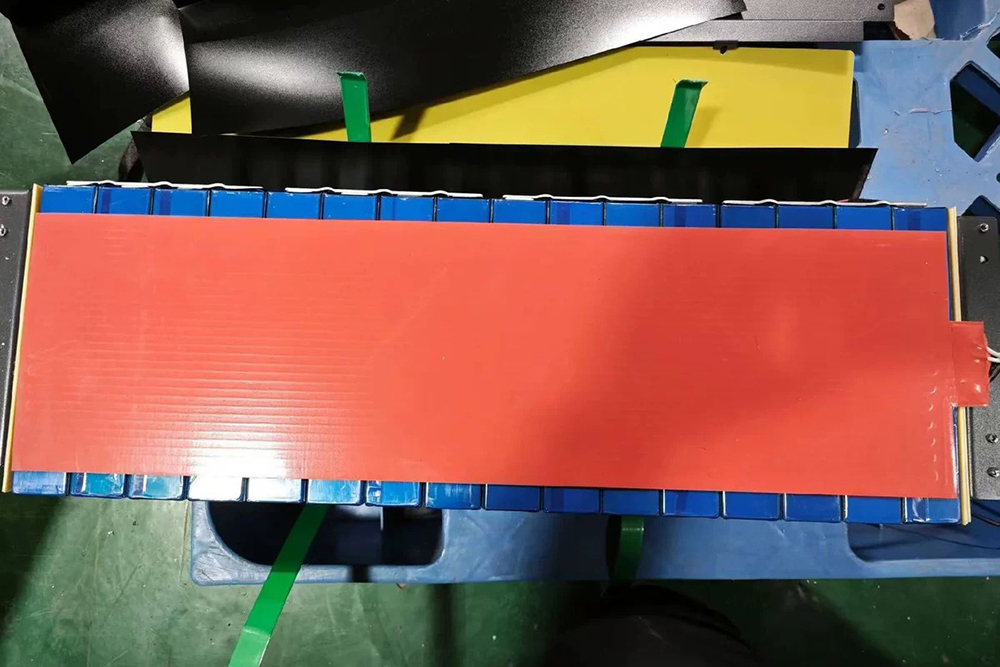
For many battery packs, installing the heating pad on the bottom of the battery enclosure is an effective solution.
The heat can transfer upward through the enclosure and battery pack.
Depending on the battery construction, other installation positions may include:
• Bottom surface
• Side surface
• Multiple surfaces
• Battery enclosure wall
The best location depends on the internal cell arrangement and thermal design.
Good thermal contact between the heater and the battery enclosure is important.
If adhesive backing is used, the mating surface should be clean, dry, and suitable for the adhesive’s operating temperature.
Silicone Rubber Heater vs. Polyimide Heater
Two common flexible heater technologies are silicone rubber heaters and polyimide heaters.
Silicone Rubber Heating Pad
Silicone rubber heaters are widely used for battery heating because they are:
• Flexible
• Durable
• Easy to install
• Available in customized sizes
• Suitable for relatively large heating areas
• Available with adhesive backing
• Suitable for outdoor and industrial applications when properly designed
For many LiFePO4 battery packs, silicone rubber heating pads are a practical solution.
Polyimide Heating Pad
Polyimide, also known as Kapton, heaters are extremely thin and lightweight.
They are especially useful when:
• Installation space is limited
• Low thickness is important
• Fast thermal response is required
• The heater needs to fit a compact surface
The appropriate heater material should be selected according to temperature, flexibility, environmental conditions, thickness requirements, and installation method.
How to Improve Battery Heating Efficiency
Simply increasing heater wattage is not always the best solution.
Several factors can improve heating performance:
1. Use thermal insulation
Insulating the battery enclosure reduces heat loss and allows more heater energy to remain inside the battery system.
2. Increase the heating contact area
A larger heating area can distribute heat more evenly and reduce localized hot spots.
3. Use a temperature sensor close to the battery cells
The sensor should measure the temperature that matters for battery protection rather than simply measuring the surrounding air temperature.
4. Use temperature hysteresis
A 2–5°C control range, for example, prevents unnecessary rapid switching.
5. Select the correct heater power
Higher power does not automatically mean better performance. Excessive heating power can create localized overheating and unnecessary energy consumption.
Safety Considerations for LiFePO4 Battery Heating
Battery heating systems should be designed with multiple layers of protection.
A typical system may include:
Battery → Fuse → Heater → MOSFET/Relay
and:
NTC Sensor → Temperature Controller → MOSFET/Relay
Additional protection can include:
• Independent thermostat
• Thermal fuse
• Over-temperature protection
• BMS protection
• Over-current protection
• Properly rated wiring and connectors
The heater should never be allowed to operate outside its specified temperature range.
The heating system should also be designed so that a sensor failure or controller failure does not create an unsafe heating condition.
Can a LiFePO4 Battery Heater Run Directly From the Battery?
Yes, a DC heating pad can be powered directly from a suitable LiFePO4 battery system, provided that the heater voltage, current, wiring, fuse, controller, and BMS are correctly matched.
For example, a 12V / 100W heater requires approximately:
8.3A at 12V
If the heater operates continuously for one hour, its theoretical energy consumption is approximately:
100Wh
Actual battery energy consumption depends on heater duty cycle and thermal conditions.
This is an important consideration for off-grid systems because battery heating consumes energy that could otherwise be used by the load.
Custom LiFePO4 Battery Heating Pads
For commercial and OEM applications, battery heating pads can be customized according to the battery pack design.
Customization options may include:
• Heater dimensions
• Voltage
• Wattage
• Heating area
• Resistance
• Lead wire length
• Wire type
• NTC sensor
• PT100 sensor
• Adhesive backing
• Connector
• Mounting holes
• Shape
• Waterproof construction
• Thermal protection
For example, a customized product can be specified as:
12V / 100W Silicone Rubber LiFePO4 Battery Heating Pad
with:
• Customized dimensions
• NTC 10K sensor
• Adhesive backing
• 2-wire power cable
• Optional thermal fuse
• Customized connector
This approach allows the heater to fit different battery enclosures and energy storage systems.
Frequently Asked Questions
Can LiFePO4 batteries be charged below 0°C?
Charging below the permitted temperature range can damage LiFePO4 cells. The exact charging temperature range depends on the specific cell and battery manufacturer’s specifications. A low-temperature protection system and battery heater can be used where appropriate.
What temperature should a LiFePO4 battery heater turn on?
A common example is to turn the heater on at approximately 2°C or below and turn it off at approximately 5°C or above. However, these values should be configured according to the battery manufacturer’s specifications.
What wattage heater is suitable for a 100Ah LiFePO4 battery?
For a typical 12.8V 100Ah battery, 80–120W can be a reasonable starting range for evaluation. The final power depends on battery dimensions, insulation, ambient temperature, and required heating time.
Is NTC suitable for a LiFePO4 battery heater?
Yes. NTC 10K sensors are commonly suitable for simple battery heating control because they are compact, inexpensive, and responsive.
Where should a battery heating pad be installed?
The bottom of the battery enclosure is often a practical location, but the optimum position depends on the battery’s internal structure and thermal design.
Is a silicone rubber heater suitable for LiFePO4 batteries?
Yes. Silicone rubber heating pads are flexible, customizable, and suitable for many battery heating applications when the heater is properly designed and temperature controlled.
Does a battery heater consume a lot of energy?
Energy consumption depends on heater power and operating time. A 100W heater running continuously for one hour consumes approximately 100Wh. With proper insulation and temperature control, the heater normally operates intermittently rather than continuously.
Conclusion
A properly designed LiFePO4 battery heater can provide controlled low-temperature heating for lithium iron phosphate battery systems.
For a typical 12.8V 100Ah battery, a 12V / 100W silicone rubber heating pad with an NTC 10K temperature sensor can be a practical starting configuration. A control strategy such as 2°C ON and 5°C OFF can provide temperature hysteresis, while independent over-temperature protection adds another layer of safety.
However, heater power, temperature settings, installation location, insulation, and protection devices should always be determined according to the actual battery specifications and operating environment.
For OEM and custom battery applications, heating pads can be manufactured in different sizes, voltages, wattages, shapes, sensor configurations, and cable specifications to match the battery pack design.
If you have any interests,CLICK HERE to check more products and ask for help for Design and Offer.
We specialize in designing products to your specific requirements. Let us help you find the right solution.
Contact Us