Simulating Real Heat Loads for AI Servers, GPU Clusters, and High-Density Computing Systems
As artificial intelligence, large language models, high-performance computing (HPC), and high-density data centers continue to evolve, the power density of computing equipment is increasing rapidly.
Traditional air cooling systems are becoming increasingly difficult to meet the thermal management requirements of high-power AI servers and GPU clusters.
As a result, direct-to-chip liquid cooling, cold plate cooling, and immersion cooling technologies are becoming important solutions for modern data centers and high-density computing infrastructure.
However, developing a reliable liquid cooling system requires more than simply circulating coolant. Manufacturers and research laboratories must accurately test how a cooling loop performs under different thermal loads.
This is where an AI data center liquid cooling test heater becomes essential.
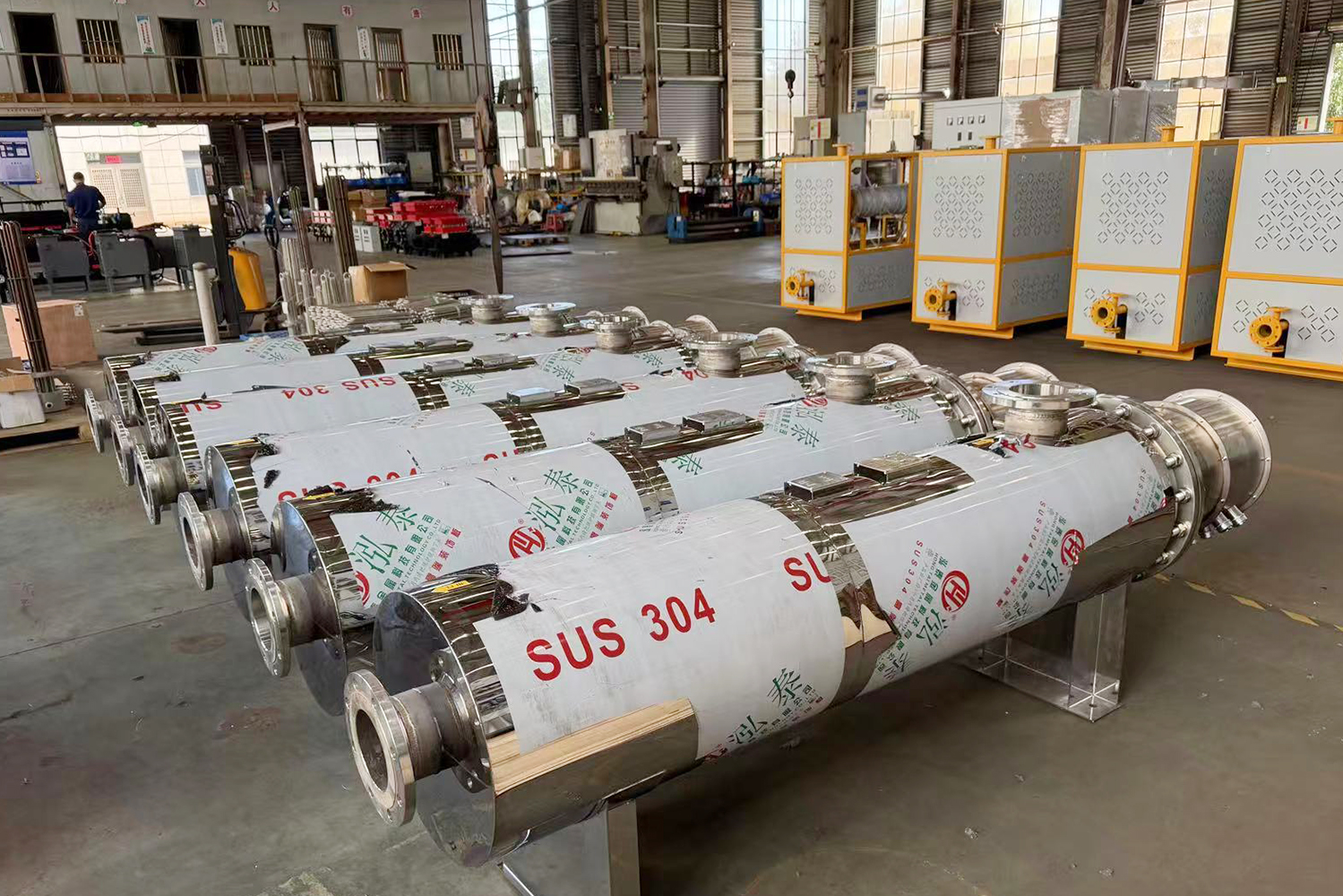
A liquid cooling test heater is a specialized electric heating system designed to simulate the heat generated by servers, GPUs, AI computing clusters, and other high-power electronic equipment. By providing a stable and controllable thermal load, the system helps engineers test cooling capacity, temperature response, flow performance, and overall system reliability.
What Is an AI Liquid Cooling Test Heater?
An AI liquid cooling test heater, also known as a liquid cooling thermal load simulator or high-temperature simulation electric heater, is designed to generate controlled heat inside a liquid cooling loop.
Instead of using an actual server or GPU as the heat source, the test system uses electric heating elements to simulate different operating conditions.
The heater transfers controlled thermal energy into the circulating cooling medium, allowing engineers to reproduce conditions such as:
• Normal operating thermal loads
• High-power computing loads
• Continuous full-load operation
• Rapid temperature rise
• Long-duration thermal cycling
• High-temperature stress testing
This provides a repeatable and controllable testing environment for liquid cooling equipment.
Why Is a Dedicated Liquid Cooling Test Heater Needed?
During the development of AI servers and liquid cooling systems, using real computing equipment as a heat source can create several challenges.
Actual server heat generation may vary depending on:
• CPU and GPU workload
• Software operation
• Power consumption
• Server configuration
• Environmental temperature
• Operating time
These variables can make testing difficult to standardize.
A dedicated electric thermal load simulator provides a more controlled alternative.
By adjusting heating power and temperature parameters, engineers can simulate specific thermal loads without depending on actual computing hardware.
This makes it easier to perform:
• Product validation
• Factory acceptance testing
• Cooling performance evaluation
• System commissioning
• Reliability testing
• Thermal aging tests
The result is improved testing consistency and better repeatability of experimental data.
Simulating AI Server and GPU Heat Loads
Modern AI computing systems can generate significant amounts of heat during continuous operation.
Liquid cooling systems must efficiently remove this heat to maintain stable operating temperatures.
A liquid cooling test heater can simulate the thermal behavior of equipment such as:
• AI servers
• GPU servers
• High-performance computing systems
• AI training clusters
• High-density server racks
• Data center liquid cooling loops
The heater acts as a controlled artificial heat source.
Engineers can increase or decrease heating power to simulate different computing loads, making it possible to evaluate how the cooling system responds to changing thermal conditions.
Designed for Closed-Loop Liquid Cooling Systems
Industrial liquid cooling test heaters can be designed for installation in closed-loop circulation systems.
Depending on the application, the system can be configured for compatibility with different cooling media, such as:
• Water
• Deionized or purified water, where system materials are appropriately selected
• Water-glycol solutions
• Certain dielectric or specialty cooling fluids, subject to material compatibility verification
Because different coolants have different chemical and thermal properties, heater materials and sealing components should always be selected according to the actual working medium.
A properly designed system can provide stable heating performance while helping maintain the cleanliness and reliability of the liquid cooling loop.
Fast Thermal Response for Liquid Cooling Testing
One of the main advantages of an electric heating system is its fast response.
Compared with waiting for natural heat generation from actual computing equipment, an electric heater can introduce a controlled thermal load directly into the test loop.
This allows the coolant temperature to rise in a more predictable manner.
Depending on the system design, engineers can simulate:
Normal Operating Conditions
Used to evaluate the cooling system during standard operation.
High-Load Conditions
Used to simulate intensive AI computing or GPU workloads.
Continuous Full-Load Operation
Used to evaluate long-term thermal stability.
Rapid Temperature Rise
Used to test cooling response and control system performance.
Thermal Cycling
Used to evaluate equipment performance during repeated heating and cooling cycles.
High-Precision Temperature Control
Temperature control is one of the most important functions of a liquid cooling thermal test system.
An advanced test heater can be integrated with a closed-loop temperature control system.
Depending on the required configuration, the system may include:
• Temperature sensors
• PID temperature controllers
• PLC control systems
• Power controllers
• Flow monitoring
• Pressure monitoring
• Data acquisition interfaces
These components allow the heating system to respond to changes in coolant temperature and operating conditions.
Precise temperature control helps engineers evaluate:
• Cooling capacity
• Temperature stability
• Temperature uniformity
• Cooling response time
• Flow compatibility
• Heat exchange performance
• Control accuracy
For data center cooling systems, stable and repeatable testing conditions are essential for obtaining meaningful performance data.
What Can a Liquid Cooling Test Heater Measure?
When integrated into a complete test platform, a thermal simulation heater can support the evaluation of multiple liquid cooling parameters.
These may include:
Cooling Capacity
The system can help determine how much heat the liquid cooling loop can remove under specified operating conditions.
Temperature Response
Engineers can observe how quickly the cooling system responds when the thermal load changes.
Temperature Stability
The test system can evaluate whether the cooling loop maintains a stable operating temperature during continuous operation.
Flow Performance
Combined with flow measurement equipment, the test platform can help evaluate the relationship between coolant flow rate and thermal performance.
Pressure Drop
Pressure monitoring can be used to evaluate pressure losses across pipes, heat exchangers, filters, and other components.
Heat Exchange Efficiency
The test system can provide a controlled heat input for evaluating the performance of heat exchangers and cooling equipment.
Typical Applications of AI Liquid Cooling Test Heaters
AI liquid cooling thermal simulation systems can be used in a wide range of industrial and research applications.
1. Liquid-Cooled Server Testing
Simulate the heat generated by servers to evaluate liquid cooling performance before equipment delivery or deployment.
2. GPU Cooling System Testing
Evaluate cooling capacity and temperature response for high-power GPU systems.
3. AI Computing Rack Testing
Simulate thermal loads generated by high-density computing racks and liquid cooling loops.
4. Data Center Cooling System Validation
Test the performance of cooling infrastructure under controlled thermal loads.
5. Liquid Cooling System Commissioning
Provide a controllable heat source during system installation and commissioning.
6. Laboratory Thermal Simulation
Create repeatable high-temperature conditions for research and development.
7. Thermal Aging and Reliability Testing
Support long-duration heating and circulation tests to evaluate system reliability.
8. Factory Acceptance Testing
Verify the performance of liquid cooling equipment before shipment.
Compact and Integrated System Design
A liquid cooling test heater can be designed as an integrated system according to customer requirements.
Depending on the application, the equipment can include:
• Electric heating elements
• Pipeline heater or immersion heater
• Circulation pump
• Stainless steel piping
• Valves
• Temperature sensors
• Pressure sensors
• Flow monitoring
• Expansion components
• Electrical control cabinet
• PLC control system
• Data acquisition system
• Safety protection devices
The entire system can also be designed as a skid-mounted liquid cooling test platform.
This compact structure can simplify:
• Installation
• Transportation
• Laboratory setup
• Factory testing
• System integration
Safety Protection for Continuous Testing
Liquid cooling testing may involve long operating periods, high temperatures, and continuous circulation.
For this reason, safety protection should be an important part of the system design.
Depending on the project requirements, the equipment can be configured with protection functions such as:
• Over-temperature protection
• Overload protection
• Low-flow or no-flow protection
• Dry-run prevention, where applicable
• Leakage protection
• Pressure monitoring
• Emergency shutdown
The specific protection configuration should be selected according to the actual testing process and applicable safety requirements.
A properly designed protection system helps reduce the risk of equipment damage during abnormal operating conditions.
Custom AI Liquid Cooling Test Heater Solutions
Different data center and liquid cooling projects have different requirements.
A standard heater may not be suitable for every test environment.
For this reason, customized liquid cooling test heaters can be designed according to parameters such as:
• Heating power
• Operating voltage
• Maximum operating temperature
• Coolant type
• Flow rate
• Working pressure
• Pipe size
• Connection type
• Heater material
• Heating method
• Temperature control accuracy requirements
• Control system configuration
• Communication protocol
• Data acquisition requirements
• Skid-mounted or integrated design
Our engineering team can help design an electric heating solution based on the customer’s actual liquid cooling loop and testing requirements.
Why Use Electric Heating Instead of Actual Computing Hardware for Testing?
Using actual AI servers or GPU clusters as test heat sources can be expensive and difficult to control.
An electric heating system offers several advantages.
Controllable Heat Load
Heating power can be adjusted according to the test requirement.
Repeatable Testing Conditions
The same thermal conditions can be reproduced for multiple tests.
Faster Test Setup
There is no need to configure a complete computing workload simply to generate heat.
Flexible Thermal Simulation
Different operating conditions can be simulated through controlled power and temperature settings.
Suitable for Long-Term Testing
Industrial electric heating systems can be designed for continuous operation under specified conditions.
Supporting the Future of AI and Data Center Liquid Cooling
As AI computing power continues to grow, thermal management is becoming a critical part of data center infrastructure.
Liquid cooling technology is increasingly important for applications involving:
• Artificial intelligence
• Large language models
• High-performance computing
• GPU computing
• Cloud computing infrastructure
• High-density data centers
Reliable testing equipment is required to validate the performance of these cooling systems before large-scale deployment.
An AI liquid cooling test heater provides a stable and controllable thermal source for research, development, production testing, system commissioning, and reliability evaluation.
By accurately simulating different heat loads, manufacturers and engineers can better understand the thermal performance and operating limits of liquid cooling systems.
Frequently Asked Questions
What is an AI liquid cooling test heater?
An AI liquid cooling test heater is an electric heating device used to simulate the thermal load generated by AI servers, GPUs, and high-density computing equipment in a liquid cooling system.
What cooling fluids can be used?
The system can be designed for water, water-glycol solutions, and other compatible cooling fluids. Material compatibility should always be confirmed before selecting the heater and sealing components.
Can the heating power be customized?
Yes. Heating power can be customized according to the thermal load required for the test system.
Can the system include a circulation pump?
Yes. A complete skid-mounted test system can be configured with a circulation pump, piping, valves, sensors, and an electrical control system.
Can the heater simulate different AI computing loads?
Yes. By controlling the heating power and temperature parameters, the system can simulate different thermal load conditions.
Is the system suitable for continuous operation?
The system can be designed for continuous operation according to the specified duty cycle, operating temperature, pressure, and cooling medium.
Can the control system be customized?
Yes. Depending on the project, the system can be configured with PID controllers, PLC systems, sensors, data acquisition, and communication interfaces.
Custom Liquid Cooling Thermal Simulation Equipment for Data Centers
A reliable thermal test platform requires more than a standard electric heater.
It requires a heating system designed around the actual coolant, flow conditions, pressure, temperature range, and testing objectives.
Hotbox Heater provides customized industrial electric heating solutions for liquid cooling systems, thermal simulation equipment, pipelines, tanks, and industrial process applications.
We can customize:
✓ Heating power
✓ Voltage
✓ Heater structure
✓ Pipeline connections
✓ Circulation pumps
✓ Temperature control systems
✓ PLC control cabinets
✓ Sensors and instrumentation
✓ Skid-mounted systems
✓ Complete liquid circulation test platforms
Whether you are developing an AI server liquid cooling system, GPU cooling test platform, data center thermal management system, or industrial liquid cooling loop, we can help provide a customized electric heating solution based on your technical requirements.
Contact us today to discuss your liquid cooling testing project.
We specialize in designing products to your specific requirements. Let us help you find the right solution.
Contact Us