As standard heat sources for FDM (Fused Deposition Modeling) 3D printer hot beds, both heating pads are adhered to the bottom of aluminum or glass build plates. Their core function is to keep the hot bed at constant temperature and prevent print warping caused by filament shrinkage upon cooling.
Why does 3D printer suffer from edge warping? Warping occurs due to thermal shrinkage of printing filaments during cooling. Different materials come with varying shrinkage ratios, resulting in different degrees of warpage. It is an inevitable physical phenomenon that can only be alleviated rather than completely eliminated. Many users assume a heated bed is unnecessary for PLA printing, which is incorrect. PLA from different manufacturers performs differently: some barely warp, while others show severe edge curling.
A heated bed cannot eliminate warping entirely but effectively mitigate it. Working principle: the heating pad warms up the build plate to keep printed parts at a relatively constant high temperature (60℃ for PLA, 100℃ for ABS), slowing down filament cooling and minimizing model warping.
Both Hotbox's PI polyimide heating pads and silicone heating pads can be custom-made in customized shape, dimension, voltage and power per customer requirements. Featuring easy installation and adjustable temperature control, they stand as the top-choice heating solution for FDM 3D printer hot beds.
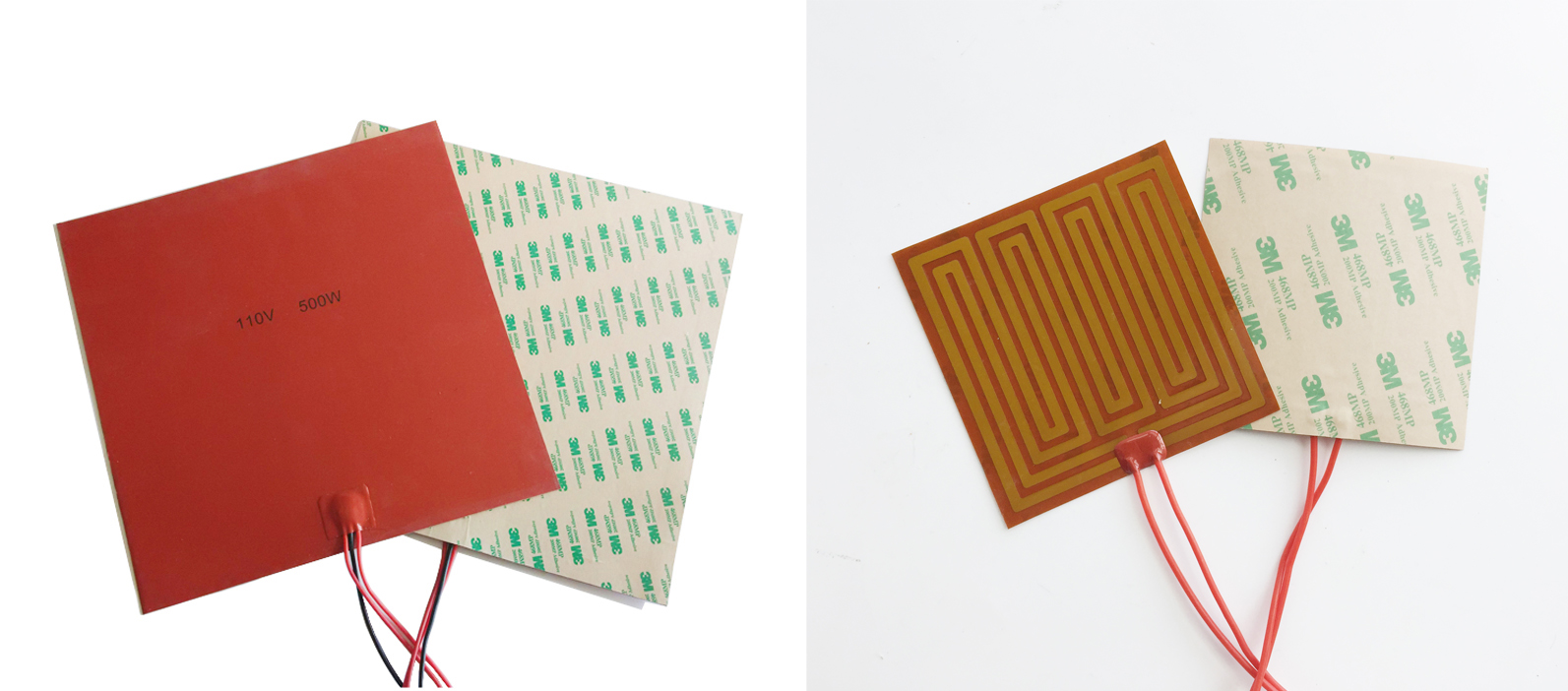
l Base material: Polyimide film, ultra-thin & flexible with even heat distribution and fast temperature rise
l Application: Small desktop 3D printers (mostly 220/310 series models), standard low-voltage DC: 12V / 24V
l Advantages: Slim thickness & light weight, rapid thermal response, customizable irregular shapes; pre-attached adhesive ensures seamless bonding to hot bed; excellent heat resistance and superior electrical insulation
l Temperature control: Matched with NTC thermistor and mainboard control; recommended bed temp: 60℃ for PLA, 100℃ for ABS
l Base material: Alloy resistance wire encapsulated in silicone rubber, high flexibility and fold resistance, thicker than PI heating pads
l Application: Medium & large-format industrial 3D printer hot beds, customizable for either 220V AC or low-voltage DC
l Advantages: High mechanical strength & impact resistance, outstanding thermal insulation; ideal for large-size high-power hot beds with waterproof & moisture-proof performance
l ABS features high shrinkage rate and is prone to severe warping; standard recommended bed temperature: approx. 100℃
l PLA has relatively low shrinkage rate, yet poor-quality off-brand PLA still suffers obvious warping; suggested constant bed temperature: 50~60℃
1. Non-standard customization: Customizable outline, dimension, rated voltage (12V/24V/110V/220V) and power to fit hot beds of any specification;
2. Easy installation: Pre-coated high-temperature double-sided adhesive on the back; peel off the liner and stick flat onto the hot bed bottom directly;
3. Precise temperature control: Built-in NTC thermistor connects to printer mainboard for accurate constant temperature regulation and overheat power-off protection;
4. Market position: PI and silicone heating pads are the dominant preferred heating accessories for FDM 3D printer hot beds globally.
l Small desktop printers (Build size ≤300mm): Choose PI polyimide heating pad for its slim profile and fast heating speed;
l Large industrialprinters (Build size >300mm): Choose silicone heating pad for high power output and robust long-term stability.
If you have any interests about the 3D printer heater,pls contact Hotbox Heater.
We specialize in designing products to your specific requirements. Let us help you find the right solution.
Contact Us